
For adults over 50, machines vs free weights is close to a tie. Pooled data from controlled trials shows the two build muscle about equally well, and strength gains mostly track whichever tool you practice on. The better question is which one you will actually use twice a week for the next year, because consistency decides the outcome far more than the equipment does. For most people restarting after time away, the honest answer is both, sequenced: machines or bands first to groove the patterns, then free weights as your control improves.
- Two meta-analyses of head-to-head trials found no difference between machines and free weights for muscle growth (SMD -0.055, p = 0.751) or for direct strength.
- Strength is specific to the tool. Free-weight tests favor free-weight training, machine tests favor machines, and neutral tests show no difference.
- Resistance bands are a legitimate third option. A review of 8 studies found elastic resistance produced strength gains similar to conventional weights.
- Honest caveat: those head-to-head trials enrolled adults aged 18 to 60. The research run specifically in adults 60 and older is the band research.
- Practical sequence after years away: machines or bands for the first few weeks, then blend in free weights as control improves.
The short answer: pick the tool you will keep showing up for
Both work. That is the least satisfying answer and the best-supported one.
Pooled head-to-head trials put the muscle-growth results on top of each other, and the strength results depend almost entirely on how strength was measured. The authors of one of the reviews covered below, published in the Journal of Sports Medicine and Physical Fitness, recommended that people choose whichever activity they prefer and are more likely to stick with. That is a research conclusion, not a motivational line.
For an adult in their 50s or 60s starting again, that shrinks the equipment question. Which setup gets you into the building twice a week through a Billings winter is what moves the numbers.
What the research actually shows
Two independent meta-analyses have examined this question over overlapping pools of trials. Both found a tie for muscle growth and a clear pattern for strength.
One of them, published in BMC Sports Science, Medicine and Rehabilitation in 2023, pooled 13 studies covering 1,016 participants aged 18 to 60. It found no significant difference between machine and free-weight training for muscle growth (SMD -0.055, p = 0.751), direct strength (SMD 0.084, p = 0.387), isometric strength (p = 0.660) or jump performance (p = 0.290). One comparison did separate: when strength was tested with free weights, free-weight training came out slightly ahead (SMD -0.210, 95% CI -0.391 to -0.029, p = 0.023).
The second review reached the same place from the other direction. Strength gains tracked the testing tool: free-weight tests favored free-weight training (ES 0.655), machine tests favored machine training (ES -0.784), and neutral tests showed no meaningful difference (ES 0.128). Muscle growth showed no difference (ES -0.01, CI -0.525 to 0.545), and neither did power.
One trial inside that evidence base shows the pattern. An 8-week randomized trial in the Journal of Strength and Conditioning Research assigned 46 participants to machines or free weights. Biceps and quadriceps thickness increased in both groups with no difference between them, and strength improved roughly 11 to 19 percent in both. The machine group gained more on the machine bench press, 13.9 percent against 8.6 percent. You get strong at what you practice.
Now the part most articles on this topic skip. Those head-to-head trials enrolled adults aged 18 to 60, and the one just described averaged about 22 years old. Nobody has run a large machine-versus-free-weight comparison specifically in adults over 50. The tie is the best evidence available, not evidence collected in your age group. What does exist in volume is research on resistance training later in life, which we covered in building muscle after 60.
Where machines have the edge
Machines ask less of your coordination while you are learning, which is why they suit the first weeks back.
The path is guided. You sit down, set a pin, and the only decision left is how hard to push. For someone who has not squatted with a weight in ten years, taking out the balance demand frees attention for effort and range, and it often shortens the learning curve from several sessions to one. Load changes take seconds, and the setting is a number you can repeat.
Walking into a gym after a long layoff is the hardest part for most people, which we wrote about in the three lies keeping you out of every gym in Billings. A machine you can use correctly on day one is a reasonable place to start.
What we will not claim is that machines are safer. No study has compared injury rates between the two head to head. Machines ask less of your coordination, which is not the same thing.
Where free weights have the edge
Free weights make you stabilize the load yourself, and that demand is the point.
A dumbbell does not travel on rails. Holding it in position recruits the smaller muscles around the shoulder, hip and trunk that a guided path takes out, and standing, single-leg and carrying movements add balance and coordination on top of the strength demand. That resembles life outside the gym: a bag of dog food into the truck bed, groceries up the front steps, a grandchild off the floor. A few dumbbells and a bench also cover squats, hinges, presses, rows and carries in a garage corner.
The one significant finding in the 2023 meta-analysis points this way: when strength was tested with free weights, free-weight training won. If you want to be strong with objects in your hands, practice with objects in your hands, and how heavy you should be lifting after 50 covers the loading question.
Resistance bands vs free weights: a real third option
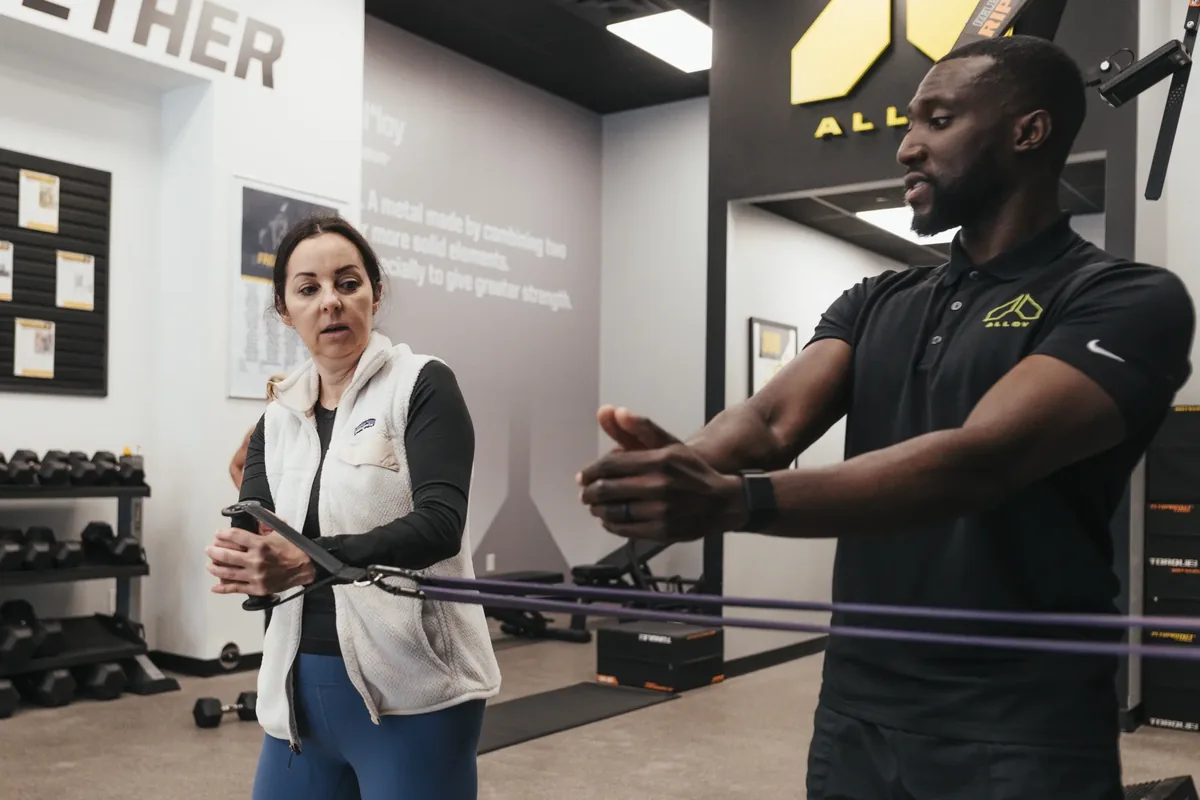
Bands are not a downgrade. For building strength, the research puts elastic resistance roughly level with conventional weights.
A meta-analysis in SAGE Open Medicine pooled 8 studies covering 224 participants aged 15 to 88 and found no significant difference in strength gains between elastic and conventional resistance training, in the upper limbs (SMD -0.011, p = 0.48) or the lower limbs (SMD 0.09, p = 0.52). The authors concluded that elastic resistance can promote strength gains similar to conventional training.
Bands are also the option with the most evidence in adults over 60. A 2025 review in Frontiers in Sports and Active Living pooled 25 randomized trials covering 1,318 participants aged 60 and over, and reported improvements in chair-stand performance (SMD 2.04, p = 0.006), leg-extension strength (SMD 1.01, p = 0.002), timed-up-and-go scores (SMD -1.41, p = 0.003) and functional reach (SMD 1.63, p = 0.012). Programs of 8 weeks or longer were the most consistent.
The limits are real. Resistance changes as the band stretches, load is hard to quantify, and strong legs will outgrow most bands. Bands earn their place as a complement and a travel option, not as the whole program.
Side by side:
| Machines | Free weights | Resistance bands | |
|---|---|---|---|
| Learning curve | Shortest, the path is guided | Longer, you manage path, load and balance at once | Short, anchoring takes practice |
| Stabilizer demand | Low by design | High, where the carryover comes from | Moderate, shifts with anchor position |
| Strength that tests best | Machine tests (ES -0.784) | Free-weight tests (SMD -0.210; ES 0.655) | Not directly compared |
| Best use coming back | First few weeks, grooving patterns | Once patterns feel controlled | Home and travel work |
Coming back after time away: what the data says
If you have not trained in years, you are in the majority, not behind.
NCHS data for 2020 found that only 21.6 percent of men and 17.6 percent of women aged 50 to 64 met both the aerobic and muscle-strengthening guidelines, with 15.3 percent and 10.8 percent aged 65 and over. CDC survey data from 2022 put 22.5 percent of all adults 25 and older at the same mark. The guideline is modest: strengthening activity for all major muscle groups on at least 2 days a week.
On safety, a systematic review in the Journal of Orthopaedic Surgery and Research pooled 28 studies and reported resistance-training injury incidence from 0.21 to 18.9 per 1,000 hours depending on the style. Traditional strength training sat at the low end, under 1 injury per 1,000 training hours, against 3.2 for weightlifting, 4.0 for powerlifting, 4.2 for CrossFit and high-intensity functional training, and 5.5 for strongman. Shoulders and the lower back were most affected.
That review compared training styles, not machines against free weights, so it says nothing about which tool to pick. What it does suggest is that ordinary structured strength training sits at the low end of the range.
How to choose: a simple framework
Match the tool to your training age, not to an opinion about which one is better.
Never trained, or years away from it. Start mostly on machines and bands. Learn the patterns and build the habit without also managing balance, then add a free-weight basic or two, like a goblet squat or a dumbbell row.
Trained before, off for a year or two. Blend from the start, lighter than memory suggests. Patterns come back faster than tissue adapts, and that gap is where people overreach in week two.
Training consistently, want more carryover. Shift toward free weights and standing work, keeping machines for the lifts where you want to push hard without minding the path.
A tie in the research hands the deciding vote to adherence. The best tool is the one still in your routine next March.
Why the mix is easier with a coach in the room
Which tool, which week, at which load is the work a program should be doing for you.
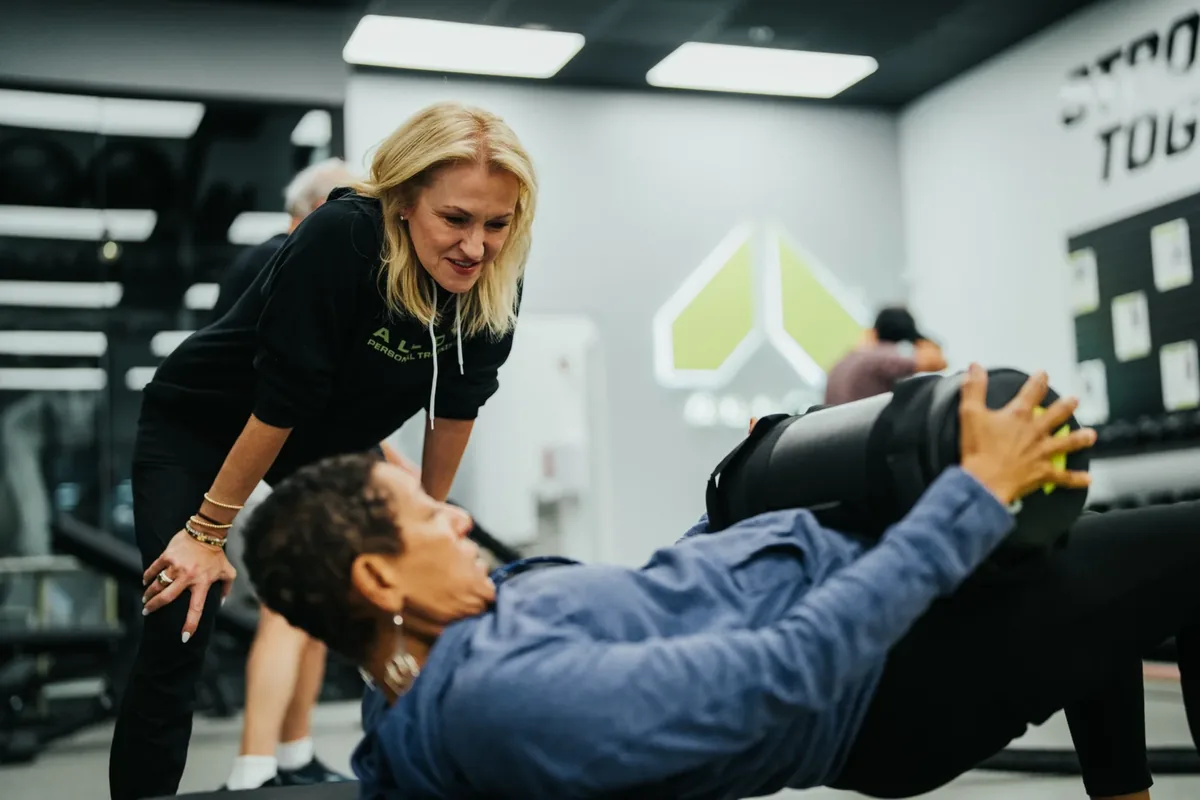
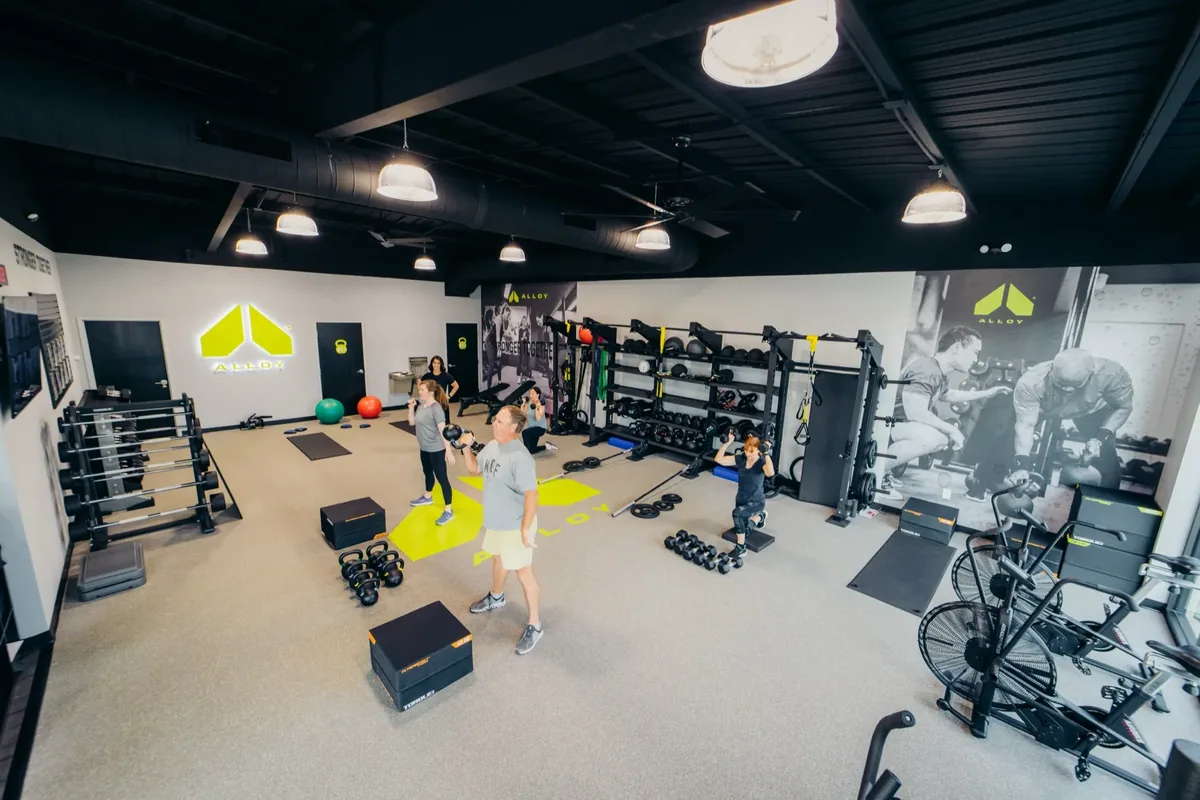
Sessions in our studio run about 55 minutes and are capped at six members, with a coach leading start to finish. Every exercise is progressed or modified per person, so two members can train the same pattern on different equipment in the same session.
That calibration is the argument for the small group personal training format over training alone. Members do not simply join a gym – they join a coaching relationship, and the coaches know every member by name. Alloy Personal Training Billings has worked with adults in their 40s through their 70s since 2022.
Frequently asked questions
Are machines good for building muscle after 50?
Yes. In the pooled trials, machines and free weights produced no significant difference in muscle growth, with effect sizes essentially at zero in both meta-analyses. The caveat is that those trials enrolled adults aged 18 to 60, so this is the best evidence available rather than evidence gathered in adults over 50.
Can you get strong using only resistance bands?
You can, particularly starting from a period of inactivity. The pooled comparison of elastic and conventional resistance found no significant difference in strength gains, and trials in adults 60 and over showed gains in leg strength and everyday movement tests over 8 weeks or more. The ceiling arrives when your lower body outgrows the band.
Are free weights safe if I have not trained in years?
No research compares injury rates between free weights and machines, so anyone calling one definitively safer is going past the evidence. The injury data does place traditional strength training at the low end of the reported range, under 1 injury per 1,000 training hours. Coached form and gradual loading are the sensible response.
Should I start with machines or free weights?
Returning after years away, start mostly on machines or bands and add free weights within the first month or two. Machines shorten the learning curve, and free weights build the balance and stabilizer demands that carry over outside the gym. Sequencing them beats choosing between them.
Where to start in Billings
If you are not sure which tools belong in your first eight weeks, have someone assess how you move right now.
A Fitness Consultation at our South Shiloh studio includes a conversation about your goals, lifestyle and any physical considerations, an InBody body composition analysis, and a functional movement assessment. You leave with personalized recommendations, and straightforward pricing at your consultation, no pressure and no games. Read more about what the Fitness Consultation covers, or go ahead and book your Fitness Consultation.
This article is general educational information, not medical advice. Talk with your doctor before starting a new exercise program.