
Lift a weight you could move about 8 to 15 times, and end each set with 2 or 3 reps still in reserve. For most adults over 50, that lands around 60 to 80 percent of a maximum you never need to test. The final two or three reps should feel genuinely hard. When they stop feeling hard, add weight. Effort is what drives the result, and load is the dial you turn to reach it.
- The target is an effort, not a number on a chart: 8 to 15 reps, stopping 2 to 3 reps short of failure, roughly 60 to 80 percent of maximum.
- Across 21 studies, heavier loads produced larger maximal strength gains (effect size 0.58), while the muscle-growth difference was trivial (0.03) when sets were taken close to failure.
- In 25 trials of healthy adults between 60 and 90, the largest strength gains clustered at 70 to 79 percent of maximum, twice a week, 2 to 3 sets of 7 to 9 reps.
- Heavy training has been well tolerated under supervision. In an 8-month trial of 101 postmenopausal women averaging 65, compliance was 92 percent with one reported adverse event.
- You never need a one-rep max test. Grading each set by reps left in reserve gives you a load that adjusts to the day.
The short answer: heavy enough that the last few reps are hard
Pick the weight by how the set ends, not by what the number on the plate says.
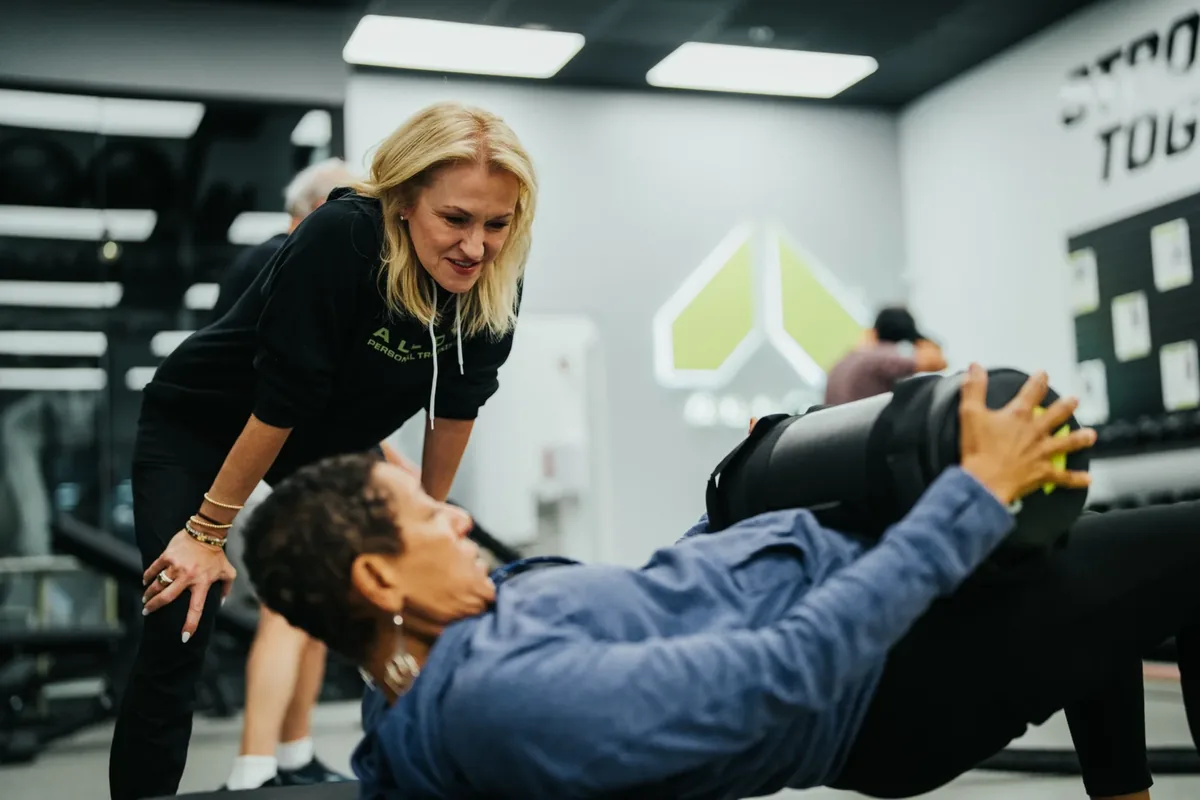
A weight you can lift 8 to 15 times with clean form, stopped while 2 or 3 reps are still available, covers most of what an adult over 50 needs from strength training. That is roughly 60 to 80 percent of a one-rep maximum, and you never have to find out what that maximum is.
Two research numbers anchor the range. Pooled trials in healthy adults between 60 and 90 put the largest strength gains at 70 to 79 percent of maximum, and the National Strength and Conditioning Association recommends working toward 70 to 85 percent. Both describe the same thing in practice: a weight that is demanding by the last rep or two.
A percentage cannot tell you how a given Tuesday will feel, which is why reading effort beats arithmetic. For the wider picture, see our guide to strength training over 50.
Heavy vs. light weights: what the research actually says
Heavier loads win for maximal strength. For muscle size, the load matters much less than the effort you put into the set.
A meta-analysis of 21 studies in the Journal of Strength and Conditioning Research compared loads above 60 percent of maximum against loads at or below it. Heavier training produced larger maximal strength gains across 14 studies (effect size 0.58), while the difference in muscle growth was effectively nothing: an effect size difference of 0.03 (95% CI -0.16 to 0.22) when sets were taken close to failure. A later review from the same group in Sports found whole-muscle growth similar across loads down to about 30 percent of maximum as long as effort was high, regardless of age or training experience, with heavier loads still superior for maximal strength.
A network meta-analysis in Medicine and Science in Sports and Exercise pooled 28 studies covering 747 adults and ranked the loads directly. High load beat low load for strength (standardized mean difference 0.60 to 0.63, p < 0.001), moderate load landed in between at 0.34 to 0.35, and high load carried a 98.2 percent probability of ranking best for strength. Hypertrophy showed no significant differences between loads. Participants there averaged 23 years old, so read it as a general training principle rather than a finding about adults over 50.
Does the answer change after 50? Less than you would think
The same pattern shows up in trials run on adults in their 60s and 70s.
A meta-analysis in the Scandinavian Journal of Medicine and Science in Sports pooled 15 studies and 448 participants at a mean age of 67.8, comparing heavy training near 80 percent of maximum against lighter work near 45 percent. Strength gains tended to be larger with heavy loads (effect size around 0.43), narrowing to roughly 0.30 once total work was matched, and differences in muscle size were marginal. With enough repetitions, lower loads still produced substantial strength gains in this age group.
The dose-response picture is more specific. A review in Sports Medicine analyzed 25 randomized controlled trials covering 819 healthy participants between 60 and 90, looking for the variables tied to the biggest strength improvements. It landed on 70 to 79 percent of maximum, two sessions per week, two to three sets, and seven to nine repetitions.
The NSCA's position statement on resistance training recommends a similar target: two to three sets, one to two multijoint exercises per muscle group, 70 to 85 percent of maximum, two to three times per week, plus faster, lighter work at 40 to 60 percent for power.
| Training variable | What the research supports | In a session |
|---|---|---|
| Load | 70 to 79 percent of maximum (Borde 2015); 70 to 85 percent (NSCA) | The last 2 to 3 reps are genuinely hard |
| Reps | 7 to 9 per working set | Sets end while form is still clean |
| Sets | 2 to 3 per exercise | Two honest sets beat five distracted ones |
| Frequency | 2 per week (Borde 2015); 2 to 3 (NSCA) | Non-consecutive days, most weeks |
| Exercises | 1 to 2 multijoint per muscle group | Squat, hinge, push, pull, carry |
| Power work | 40 to 60 percent, moved with intent | A quicker press or step-up, still controlled |
Treat that table as a destination, not a week-one plan. Whether the load comes from a machine, a dumbbell or a barbell matters far less than whether it is heavy enough, a question we take up in machines vs. free weights after 50.
"Won't heavy weights hurt me?" What supervised trials reported
In supervised trials, heavy resistance training has been well tolerated.
An eight-month randomized trial in the Journal of Bone and Mineral Research put 101 postmenopausal women at a mean age of 65 through twice-weekly supervised sessions at loads above 85 percent of maximum, in a five-sets-of-five format. Compliance came in at 92 percent, and researchers reported one adverse event across the entire program: a minor low-back spasm.
That is a tolerability finding rather than a promise, and the supervision is doing real work in it. Those participants were taught the lifts, loaded deliberately and watched set by set. The NSCA reaches the same place, concluding that a properly designed and instructed program is safe for healthy adults in this age range.
Training to absolute failure on your own is not the goal, and it is not what these programs did. Stopping two to three reps short is the better-supported habit.
How to find your working weight without testing a one-rep max
Grade the set by how many reps you had left, then adjust.
Writing in the Strength and Conditioning Journal, Helms and colleagues described a rating scale anchored to reps in reserve: a 10 means nothing was left, a 9 means one rep, an 8 means two. The same paper explains why this beats a percentage chart. Rep counts at an identical percentage of maximum vary widely between individuals, and readiness shifts day to day.
A chart that sends two people to 75 percent can hand one a hard set of 8 and the other an easy set of 14.
In practice it looks like this:
- Start lower than feels interesting. A first set that is too light costs you one set. One that is too heavy costs you a week.
- Run a set of 10 and grade it honestly. How many more could you have done with the same form? Four or more means too light, zero or one means too heavy, and you adjust on the next set rather than next month.
- Re-grade every session. The same dumbbell can be a 7 one week and a 9 the next, and both readings are correct.
None of that requires a one-rep max test, and you should not perform one to find your starting weight. Maximal testing carries supervision requirements a normal session does not.
When to add weight, and when to leave it alone
Add weight when the last reps stop being hard, and not before.
The signal is specific. If you finish at the top of your rep range with more than three reps still in reserve, that weight has done its job. Move up in the smallest increment the equipment allows.
Hold the load where it is when form changes under fatigue, when your range of motion shortens to finish the rep, or when a joint is telling you something new.
Progressive loading still deserves its priority. The NSCA statement notes that lower-limb muscle mass declines roughly 1.0 to 1.4 percent per year with age, and that strength declines two to five times faster than muscle size does.
How load gets chosen in a coached session
Picking the right weight, set after set, is most of what coaching actually is.
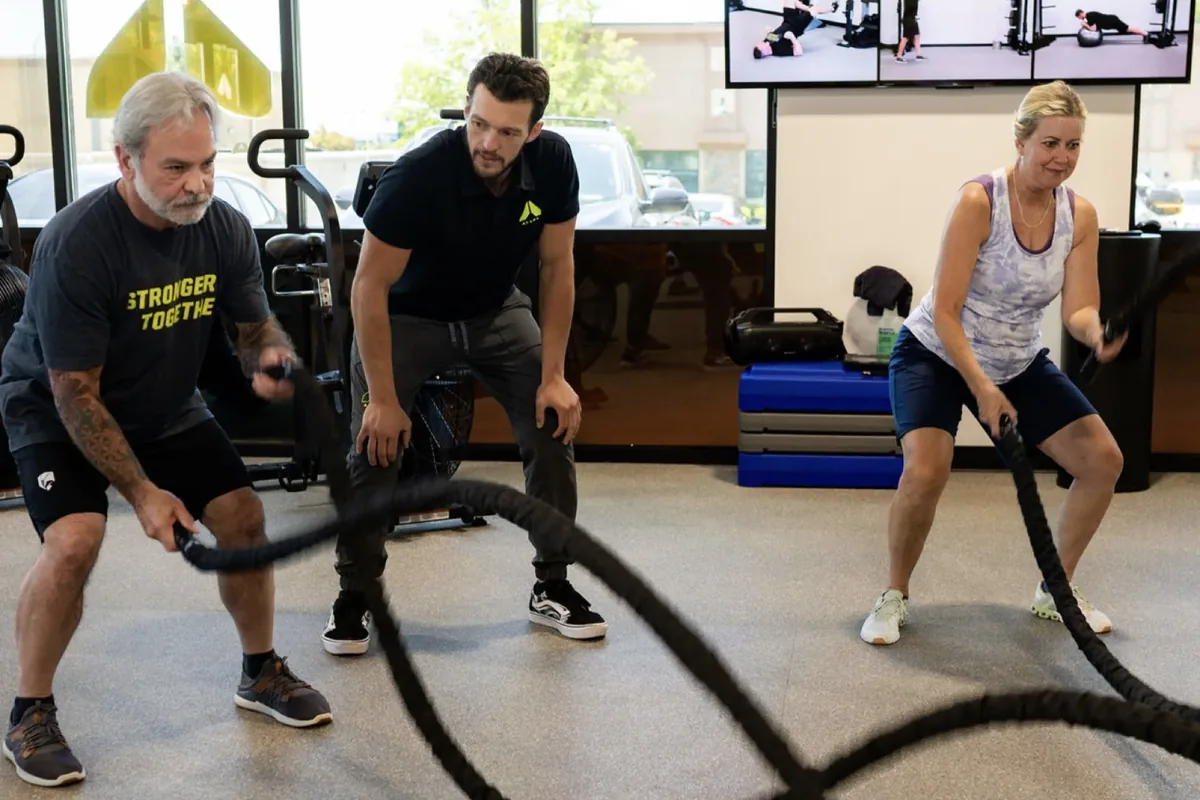
Sessions in our studio run about 55 minutes and are capped at six members, with a coach leading start to finish. Every exercise is progressed or modified per person, so two people can work the same pattern at very different loads on the same day, each finishing with two or three reps in reserve. Programming is structured and progress is tracked over time.
That per-person calibration is the argument for a small group personal training format over a follow-along class, where everyone hears the same instruction regardless of what their last set looked like. Members do not simply join a gym, they join a coaching relationship, and coaches know every member by name. Alloy Personal Training Billings has coached adults in their 40s through their 70s at the South Shiloh studio since 2022.
Frequently asked questions
Is it better to lift heavy or light weights after 50?
Heavier is better for maximal strength, and the difference for muscle size is small when effort is high. The meta-analysis of 21 studies cited above found an effect size of 0.58 favoring heavier loads for strength, against a 0.03 difference for growth. In participants averaging 67.8 years old, heavy loads near 80 percent again tended to produce larger strength gains, though lighter loads still delivered substantial gains when the reps were pushed.
How many days a week should I strength train after 50?
Two to three. The dose-response review of 25 randomized trials in healthy participants between 60 and 90 found the largest strength gains at two sessions per week, and the NSCA recommends two to three. Two sessions you attend every week beat four you attend sporadically.
Should I max out to find my starting weight?
No. Use reps in reserve instead: run a set of 10, count how many reps you could honestly have added, and adjust from there. Rep counts at a given percentage of maximum differ widely between individuals, and maximal testing carries supervision requirements a normal training session does not.
Can I start lifting at 60?
The research above was built on participants in exactly that range. The dose-response review covered healthy adults between 60 and 90, and the load-comparison meta-analysis averaged 67.8 years old. Starting with lighter loads and clean technique while the effort target gets calibrated is the standard approach, and our post on building muscle after 60 covers what to expect from the first several months.
Where to start in Billings
If you are not sure what weight belongs on the bar, the fastest way to find out is to have someone watch you lift.
A Fitness Consultation at our South Shiloh studio includes a conversation about your goals, lifestyle and any physical considerations, an InBody body composition analysis that measures muscle mass and body fat percentage, and a functional movement assessment. You leave with personalized recommendations, plus straightforward pricing at your consultation, no pressure and no games. Read more about what the Fitness Consultation covers, or book your Fitness Consultation.
This article is general educational information, not medical advice. Talk with your doctor before starting a new exercise program.