
Yes, strength training measurably improves what hiking asks of you: power on the climb, control on the descent, and steadiness on loose rock. In a review of 22 randomized trials covering 3,656 adults aged 63 to 87, resistance training improved six-minute walking distance and lower-body strength. Two sessions a week built around step-ups, split squats, single-leg hinges, calf work and loaded carries is the version that transfers to a trail. In Billings, the payoff gets measured in miles on the Rims, not numbers in a gym.
- In a review of 22 trials with 3,656 older adults, resistance training improved six-minute walking distance by 16.1 meters and lower-extremity strength.
- Climbing is the expensive part: energy cost rises roughly tenfold from level ground to a steep 45% grade.
- Descending is the sore part. A 2018 trial found significantly higher next-day soreness after downhill walking than uphill.
- Five movements do most of the work: step-ups, split squats, single-leg Romanian deadlifts, slow-lowering calf raises, loaded carries. Bodyweight, then load, then range and tempo.
- The Rims are the year-round training ground. Beartooth country is next season's goal, since the highway is open only from about Memorial Day to mid-October.
Does strength training for hiking actually work?
It does, and it shows up in the measures that matter on a trail.
Researchers writing in Innovation in Aging pooled 22 randomized controlled trials covering 3,656 adults between 63 and 87. Resistance training improved six-minute walk distance by 16.1 meters (95% CI 12.3 to 19.9), gait speed by 0.05 m/s, and lower-extremity strength with a standardized mean difference of 2.01. Covering more ground, moving faster, producing more force: that is the trail's shopping list.
None of this replaces hiking. Strength work changes what the miles cost you, and how you feel the next morning.
What a hike asks of your body: the climb, the descent, and the pack
A hike is three separate jobs, and only one resembles flat walking.
The climb is the expensive one. Minetti and colleagues, in the Journal of Applied Physiology, measured the energy cost of walking at grades from negative 45% to positive 45%. On the level, cost bottomed out near 1.64 joules per kilogram per meter. At a 45% uphill grade it reached 17.33, roughly ten times higher. That is the pitch where your legs quit before your lungs do.
The cheapest grade was not flat but about 10% downhill, at 0.81 J/kg/m, where gravity helps. Steepen the descent and cost climbs back to 3.46 J/kg/m at negative 45%, because braking is work.
Then there is what you carry. A 2022 study in Medicine & Science in Sports & Exercise tested packs at 0, 22, 44 and 66 percent of body mass and found metabolic cost rises nonlinearly with load. The jump from a light daypack to a full one costs more than the scale suggests.
Why this matters more after 40
The demands of a trail do not change with age. Your reserve does, unless you train it.
Muscle mass declines by roughly 3 to 8 percent per decade after age 30, with the rate accelerating after 60. Gradual enough to go unnoticed for years, then it surfaces as a specific complaint: the last mile of a climb feels different, or a descent leaves you stiff for two days.
National guidance treats strength as a requirement, not a bonus. The CDC recommends that adults 65 and older get at least 150 minutes a week of moderate aerobic activity, muscle-strengthening work on at least two days a week, and balance activities. Hiking covers the aerobic half on its own. The strength and balance days go missing.
It is the same argument we make about training through Montana's seasons and strength training after 50: the activity is the reward, and training is what keeps it available.
The five movements that build hiking strength
Five patterns cover most of what a trail demands, and all progress the same way: bodyweight, then load, then range and tempo.
Step-ups earn the top spot. A review of gluteal EMG research in the Journal of Sports Science and Medicine found step-up variations produced the highest gluteus maximus activation of any exercise reviewed, in the "very high" band above 60 percent of maximum voluntary contraction alongside split squats, lunges and deadlifts. A separate review of bodyweight exercises in the International Journal of Sports Physical Therapy put the unloaded forward step-up at 54.7 percent MVIC, high but a step below. Loaded step-ups top the list; bodyweight is the entry point, not the destination.
| Movement | Trail job | Bodyweight | Add load | Range or tempo |
|---|---|---|---|---|
| Step-up | Lifting your body onto the next rock | 6 to 8 inch box, hands free | Dumbbells at your sides | Box toward knee height, pause at the top |
| Split squat | Single-leg strength on uneven footing | Back foot on the floor | Goblet hold or two dumbbells | Rear foot elevated, three-second lowering |
| Single-leg Romanian deadlift | Balancing on one foot off a ledge | Fingertips on a wall | One kettlebell or dumbbell | Drop the wall, slow the descent |
| Calf raise, slow lowering | Ankles and Achilles on rocky ground | Both feet on the floor | One leg, then add weight | Off a step, four-second lower |
| Loaded carry or pack walk | Carrying water, layers and gear | Walk tall, unloaded | Suitcase carry, then a pack | More time under load, then a hill |
Load matters, and so does patience. In endurance athletes, a review of 21 studies in Sports Medicine Open found heavy resistance training improved running economy more than plyometric training (g = -0.32 versus -0.13), with the largest effects in programs lasting 10 to 14 weeks. That was done in runners, not hikers, so read it as a reason to take load and timeline seriously, not a promise about your next trail day. If you are unsure what "heavy" means for you, we covered it in how heavy you should be lifting after 50.
Why your legs hurt after hiking downhill, and how to train the descent
Your legs hurt after hiking downhill because descending loads your muscles eccentrically. Your quads and calves lengthen under tension to brake each step instead of shortening to push you up, and that braking causes more muscle damage than climbing does. The soreness usually arrives the next day rather than during the hike, which is why the descent gets blamed last and deserves it most.
The research lines up. A 2018 study in the Journal of Physiological Sciences had participants walk 30 minutes at 6 km/h on a 5 percent uphill grade and, separately, a 5 percent downhill grade. Next-day soreness was significantly higher after the downhill walk (P < 0.01), and creatine kinase, a blood marker of muscle damage, was also highest after downhill walking, though that difference was not statistically significant. Same speed, same duration, a gentler grade than anything on the Rims, and the descent still produced the soreness.
Nothing makes a long descent free. But it is a specific demand, and specific demands can be trained:
- Slow the lowering phase. Three to five seconds down into every squat and split squat. The lowering half of a lift is the same muscle action as the lowering half of a trail.
- Add step-downs. Stand on a box, lower one foot to the floor under control, tap, stand back up. The gym version of a big step off a ledge.
- Build descent exposure gradually. A three-mile out-and-back like the Four Dances trail east of downtown gives you a measured climb and a measured descent in the same hour.
The goal is not to never be sore. It is to come home less beat up than last time.
Balance for uneven terrain
Balance is trainable, and resistance training is one of the things that trains it.
A 2020 meta-analysis in Life pooled 13 randomized controlled trials of resistance exercise and balance outcomes in older adults. Functional reach improved by 4.22 cm (p < 0.001), timed up-and-go dropped by 0.55 seconds (p = 0.002), and single-leg stance time improved with a standardized mean difference of 0.62.
Those are lab measures, but the capability is the one you want on a trail that tilts. Billings has a proving ground for it: Phipps Park, whose main 4.1-mile loop runs through narrow paths, rocky terrain and tight switchbacks. Stepping across an off-camber rock without a wobble is single-leg stance, applied.
Training it is boring in the best way: anything on one leg counts, plus carries, which make your torso resist being pulled sideways.
A Billings progression: from the Rims to the Beartooths
The useful thing about training here is that the ramp already exists.
Start flat. Riverfront Park's relatively flat 4-mile loop and the couple of easy miles of river-bottom trail at Norm's Island build time on your feet without the grade tax. They double as recovery days after a hard climb.
Move up onto the Rims. Zimmerman Park offers two routes with a moderate challenge on rockier ground, and Phipps Park adds the switchbacks. For volume, Swords Rimrocks Park connects with the Skyline Trail for seven continuous paved miles atop the Rims.
Add a climb, a descent, then a pack. Four Dances Recreation Area sits on a plateau a couple of miles east of downtown, with a three-mile out-and-back to some of the best views in Billings. Walk it unloaded, then with a light pack, then with the pack you plan to carry.
Go higher. Red Lodge is about an hour southwest of Billings, with trailheads well above anything in town. A day up there shows what altitude and sustained grade do to your pacing.
Then Beartooth country, next season. The Beartooth Highway runs 68 miles from Red Lodge to Yellowstone's northeast entrance and crests Beartooth Pass at 10,947 feet, open only from roughly Memorial Day into mid-October, weather permitting. If you are reading this in the fall, the high country is a spring target and the Rims are your training ground in between. Billings sits at about 3,100 feet, so the drive to the pass climbs about 7,800 feet in a little over an hour.
Beyond it sits Granite Peak at 12,799 feet, Montana's highest point and a technical climb rather than a hike. A horizon line, not homework.
The off-season is when strength work does the most good, the case we make in our guide to training before ski season.
How this gets programmed in a small group
Hiking strength is individual, which is the argument for having a coach watch it.
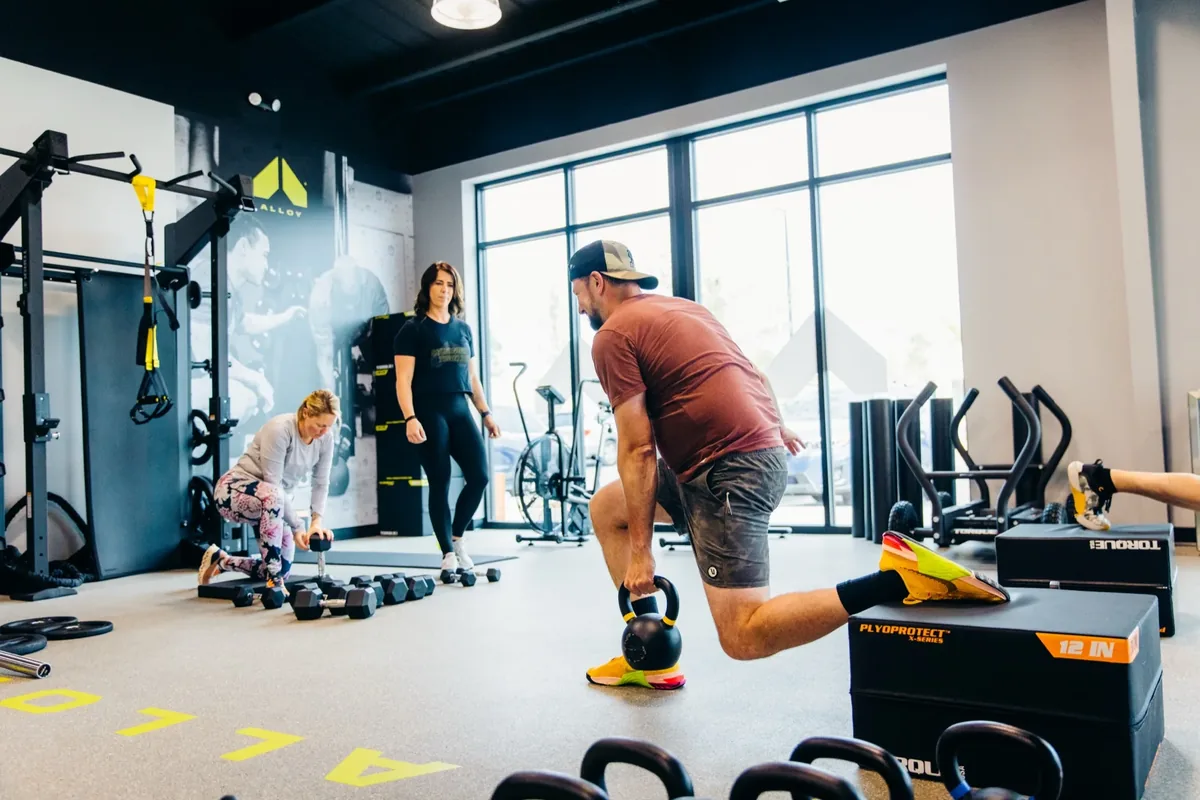
Sessions at Alloy Personal Training Billings run about 55 minutes and are capped at six members, coach-led start to finish. Every exercise is progressed or modified per person, so one member works a six-inch step-up unloaded while another loads a knee-high step-up with dumbbells, both on the same pattern at the right point on the ramp.
That calibration is what small group personal training buys you over a follow-along class. Members do not simply join a gym – they join a coaching relationship, and our coaches know every member by name.
Frequently asked questions
Why do my legs hurt so much after hiking downhill?
Because descending is eccentric work. Your quads and calves lengthen under load to brake each step, and that causes more muscle damage than climbing. In a 2018 trial, 30 minutes of downhill walking produced significantly more next-day soreness than uphill walking at the same speed. Slow lowering phases and step-downs rehearse that action, and adding descent mileage gradually beats discovering it mid-trip.
How many weeks before a big hike should I start strength training?
Roughly eight weeks is the common guidance across hiking training plans, and it is reasonable from a decent base. The endurance research argues against rushing: in runners, the largest gains in movement economy came from programs lasting 10 to 14 weeks. For a June trip, starting in March gives the work room to accumulate.
Do I need to train with a weighted pack?
Only if you plan to carry one. Start unloaded, then add the pack once the movements are solid, since load raises metabolic cost nonlinearly and each added pound is not equal to the last. Wear it on flat walks first, then a rolling loop, then the climb you are training for.
Where to start in Billings
If you are not sure whether your limiting factor is leg strength, balance or descent tolerance, the fastest way to find out is to have it assessed.
A Fitness Consultation at our South Shiloh studio includes a conversation about your goals, lifestyle and any physical considerations, an InBody body composition analysis, and a functional movement assessment. You leave with personalized recommendations, plus straightforward pricing at your consultation, no pressure and no games. Book your Fitness Consultation and we will build the plan around the trails you want next summer.
This article is general educational information, not medical advice. Talk with your doctor before starting a new exercise program.