
Flexibility is the range a joint has when something else moves it. Mobility is the range you can move into and control on your own, using strength, coordination and balance. After 50, mobility is the one that decides whether you get off the floor without a hand or load the top shelf, and training strength through a full range builds it about as well as stretching does while also making you stronger.
- Flexibility is passive range. Mobility is active, controlled range. Being loose on a stretching table does not mean you can control that range in a squat.
- A review of 11 randomized trials covering 452 participants found strength training and stretching produced statistically equivalent range-of-motion gains.
- A larger review of 55 studies and 2,756 participants agreed, and found untrained people gained more range than trained participants.
- Shoulder and hip range declines by roughly 5 to 7 degrees per decade after middle age. That is a measurable number, and a trainable one.
- Full-range lifting gives you both: range comparable to stretching, plus strength that stretching by itself does not build.
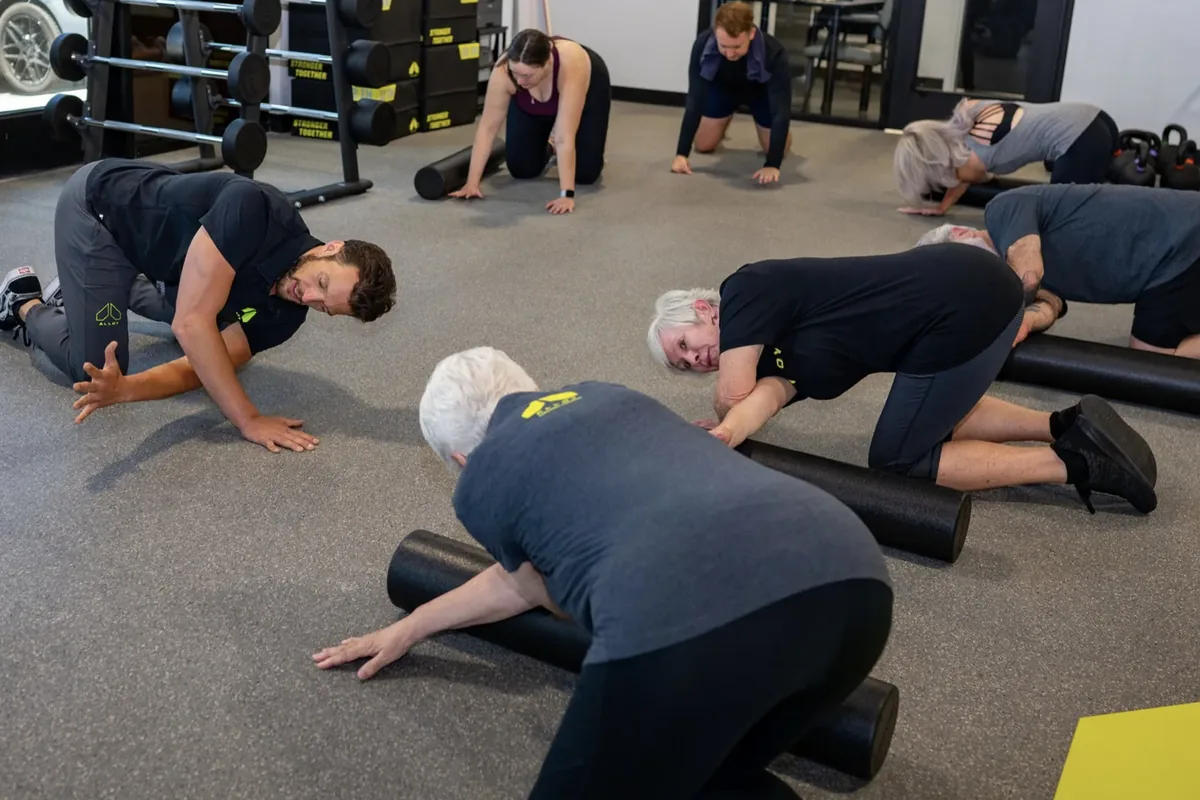
The short answer: you need mobility, and strength work is how you build it
You need both, but they are not equally useful and they are not trained the same way.
The American Council on Exercise defines flexibility as the range available at a joint, usually governed by how far muscle and connective tissue will lengthen, and mobility as the ability to actively move and control a joint through that range with strength, coordination and balance. Their summary is the cleanest version of the distinction: flexibility provides the potential for movement, and mobility determines whether that potential can be expressed during real tasks.
For an adult in their 50s, 60s or 70s, those tasks are specific. Standing up from a low chair without pushing off the arms. Kneeling in the garden and getting back up. Each one needs range you can control under load, not range someone else can push you into.
So the practical answer is usually less stretching volume and more lifting through the range you want to keep. Seen this way, strength training after 50 is a mobility strategy, not only a muscle strategy.
Flexibility vs. mobility: what the words actually mean
The difference is who is doing the moving.
Lie on your back and pull one knee toward your chest with both hands, and you are measuring flexibility. The hip may travel through a big arc, but your hands are supplying the effort. Stand up and squat to that same depth without falling backward or letting the knee collapse inward, and you are demonstrating mobility. Same joint, same arc, very different demand.
ACE uses that exact example: a person can have adequate passive hip flexion lying down and still be unable to control it in a squat. Flexible on the table, stuck in the pattern. It is one of the most common gaps we see in a movement assessment, and it explains why years of stretching sometimes fails to change how someone actually moves.
| Flexibility | Mobility | |
|---|---|---|
| What it is | The range available at a joint | The range you can actively move through and control |
| Who supplies the effort | Gravity, a strap, a partner, your other hand | You do, under your own muscular control |
| What it depends on | Extensibility of muscle and connective tissue | Range plus strength, coordination and balance |
| How it gets tested | Passive measures, like a lying hamstring stretch | Active tasks: a full-depth squat, a step-up, an overhead reach |
| What it tells you | The potential for movement | Whether that potential shows up in real tasks |
| How it gets trained | Static and dynamic stretching | Full-range strength work, controlled joint rotations, loaded patterns |
What happens to your range of motion after 50
Range of motion declines gradually with age, and the decline is measurable rather than mysterious.
A study of 436 adults between 55 and 86 published in the Journal of Aging Research found shoulder abduction declining about 5 degrees per decade in men and 6 degrees per decade in women, with hip flexion declining about 6 degrees per decade in men and 7 degrees per decade in women. The losses were not spread evenly across the lifespan either. Hip flexion decline in men accelerated around age 71, and women's shoulder range began dropping faster from around age 63.
For scale, CDC survey data shows that serious difficulty walking or climbing stairs is the most commonly reported disability among US adults, affecting roughly 1 in 7 adults overall, about 1 in 5 between 45 and 64, and about 1 in 4 at 65 and older.
That figure is context, not a forecast about any individual. The useful part of this data is that range of motion behaves like strength: it responds to what you ask of it.
Lifting through a full range matches stretching, and also makes you stronger
This is the finding most mobility articles leave out, and it is well supported.
Researchers writing in Healthcare pooled 11 randomized controlled trials covering 452 participants that compared strength training against stretching for range of motion. Their conclusion was that the two were not different in their effects, with a pooled effect size of -0.22 (95% CI -0.55 to 0.12, p = 0.206). Strength training held its own against the intervention built specifically for flexibility.
A larger review in Sports Medicine covering 55 studies and 2,756 participants reached the same place from a wider evidence base. Resistance training clearly improved range of motion compared with doing nothing (effect size 0.73, p < 0.001) and was statistically indistinguishable from stretch training (effect size 0.08, p = 0.79). Two details there deserve attention. Untrained participants improved far more (effect size 1.042) than already-trained participants (0.43), and programs using bodyweight alone showed no significant range-of-motion improvement. Load appears to matter, which is an argument for progressing past chair squats and wall pushups once you own them. We cover that in our guide to how heavy to lift after 50.
A small 8-week trial in BMC Sports Science, Medicine and Rehabilitation illustrates the same pattern at the individual level, though with six people per group it is an illustration rather than proof. Sit-and-reach improved 6.6 ± 2.6 cm in the full-range resistance training group and 6.1 ± 1.4 cm in the static stretching group, with no statistical difference between them (p = 1.000). The separation showed up elsewhere: only the lifting group got stronger, gaining 145 ± 27 N of force at the longest muscle length, while the stretching group changed by -16 ± 57 N.
The honest version of the claim is this. Lifting through a full range is comparable to stretching for range of motion, not superior to it. What it adds is strength in those long positions, and strength is what turns available range into range you can use.
Why strength training keeps you moving well day to day
Range is only half of mobility. The other half is the force to control it.
A review in the Journal of Functional Morphology and Kinesiology analyzed 17 studies with 614 participants at a mean age of 70.2 and found machine-based resistance training improved functional capacity, standardized mean change 0.72 (95% CI 0.39 to 1.07), against 0.09 in control groups. Strength improved on a similar scale (0.71). The two moved together, which is what you would expect if controlled movement depends on force production.
National guidance treats strength as non-optional for the same reason. The CDC's physical activity recommendations for adults 65 and older call for at least 150 minutes a week of moderate aerobic activity, muscle-strengthening activity on at least 2 days a week, and balance activities. Strength work supports balance and everyday movement, and it is the part most commonly skipped.
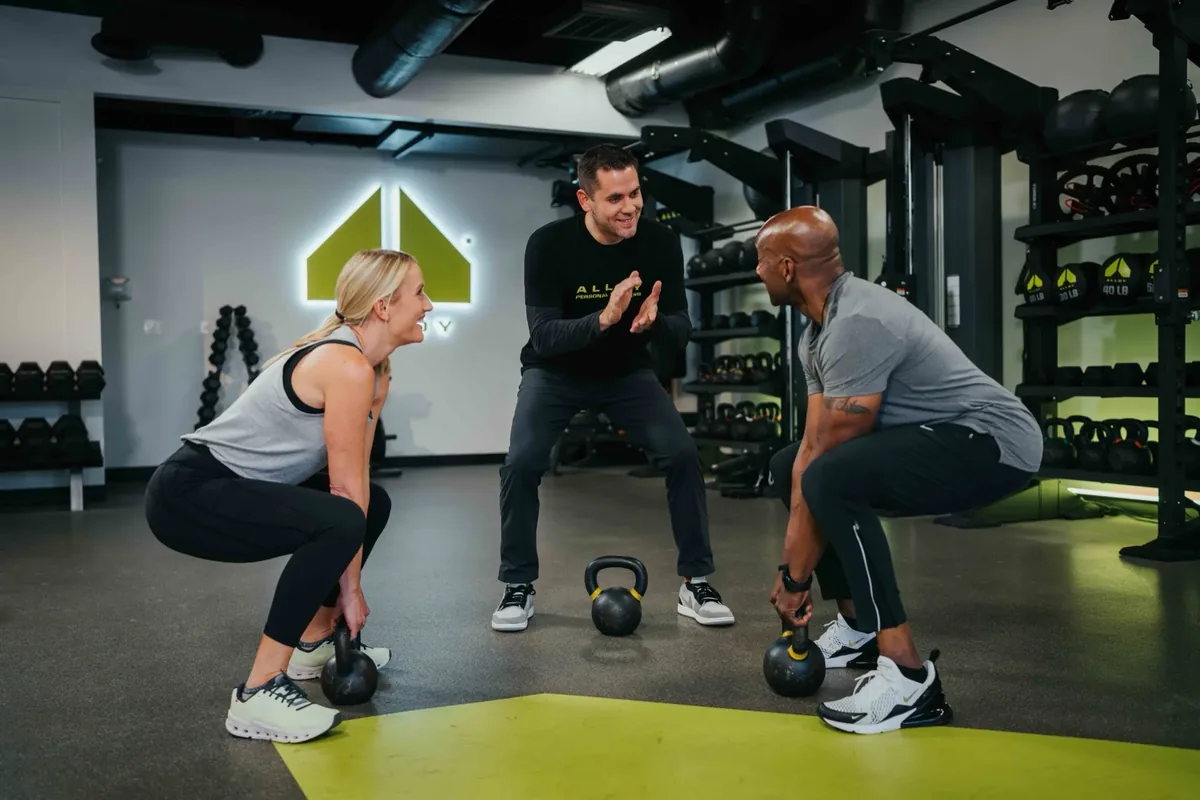
What mobility exercises for adults over 50 look like in practice
Most of the work looks like ordinary strength training performed with more range and more control than usual.
Start with controlled joint rotations. Slow, deliberate circles at the shoulders, hips and ankles, through the biggest arc you can manage under your own power. That rehearses active range instead of holding a passive stretch.
Build the session around full-depth patterns. Goblet squats taken to real depth, split squats with the back knee traveling toward the floor, Romanian deadlifts that let the hamstrings lengthen under load, presses and reaches that finish with the arms genuinely overhead. These load a joint at long muscle lengths, which is the condition the research above was testing.
Slow the tempo and own the end range. A three-second lowering phase and a brief pause at the deepest point does more for controlled range than another set. Speed hides the positions you cannot control.
Adjust the range instead of skipping the movement. If a full-depth squat is not available today, an elevated surface makes the same pattern trainable, and the height comes down over weeks. Range is a variable to progress, like weight.
Keep static stretching for after the session. It works, and it is a reasonable way to address a specific tight spot. The point is not that stretching fails, only that it is not the only tool, and it does not build the strength that holds new range in place.
How range of motion gets handled in a coached small group session
Range is an individual variable, which is the main argument for having eyes on it.
Sessions in our studio run about 55 minutes and are capped at six members, with a coach leading start to finish. Every exercise is progressed or modified per person, so two people can work the same pattern at different depths on the same day: one loading a full-depth goblet squat, another squatting to a box while the ankles and hips catch up. Both are training mobility, at different points on the same ramp.
That calibration is what a small group personal training format buys you over a follow-along class. Members do not simply join a gym – they join a coaching relationship, and the coaches know every member by name. Alloy Personal Training Billings has worked with adults in their 40s through their 70s since 2022, and range of motion is tracked and progressed over time rather than left to chance.
Frequently asked questions
What are the best mobility exercises for adults over 50?
The most useful ones are loaded, full-range versions of movements you already do: goblet squats to real depth, split squats, Romanian deadlifts, step-ups, and overhead presses or reaches. Add controlled joint rotations at the shoulders, hips and ankles as a warm-up. The common thread is moving through the range under your own control rather than being pushed into it, which is the line ACE draws between mobility and flexibility.
Is it too late to improve mobility after 60?
The evidence points the other way. In the Sports Medicine review of 55 studies cited above, untrained participants improved range of motion far more (effect size 1.042) than participants already training (0.43). Starting from a lower baseline is associated with the larger gains, not the smaller ones. The same pattern shows up in the strength research covered in our post on building muscle after 60.
Should I stretch before or after lifting?
Save longer static stretching for after the session or a separate time. Beforehand, controlled joint rotations and light versions of the movements you are about to perform prepare active range, which is what the working sets will demand. Static stretching still has a place for a specific tight spot. It just is not the best use of the few minutes before you pick up a dumbbell.
How often should I train for mobility?
If you are lifting through a full range with control, your strength sessions are already doing most of the work, and the CDC recommends muscle-strengthening activity on at least 2 days a week for adults 65 and older, alongside aerobic and balance activity. A few minutes of controlled joint rotations on non-training days is low cost and easy to keep up. Consistency over months matters more than any single session.
Where to start in Billings
If you are not sure whether your limitation is range, strength, or control, the fastest way to find out is to have someone measure it.
A Fitness Consultation at our South Shiloh studio includes a conversation about your goals, lifestyle and any physical considerations, an InBody body composition analysis, and a functional movement assessment that looks at how you actually move through your available range. You leave with personalized recommendations, and straightforward pricing at your consultation, no pressure and no games. Read more about what the Fitness Consultation covers, or go ahead and book your Fitness Consultation.
This article is general educational information, not medical advice. Talk with your doctor before starting a new exercise program.