
The most useful core exercises for adults over 60 are not crunches. They are movements that train the trunk to resist motion while the arms and legs do the work: the dead bug, the bird dog, the front plank, the side plank, the farmer's carry, the suitcase carry, the Pallof press, and the standing anti-rotation chop. Every one can be made easier or harder without changing the pattern, which is what makes them practical at 62 and at 78. Here is how each move works, what good form looks like, and how to progress it.
- Your core's job is to resist motion, not create it. It holds the spine steady while the hips produce force.
- Harvard Health notes that sit-ups and crunches "are not as effective as we once believed" and largely train the hip flexors.
- A systematic review of core training in older adults reported trunk strength gains near 30% and balance and function gains near 23%.
- An independent 2025 meta-analysis of adults 60 to 85 found better functional reach and about 3.2 extra seconds of one-leg stance.
- Every exercise below has a way down and a way up, so the pattern stays the same while difficulty changes.
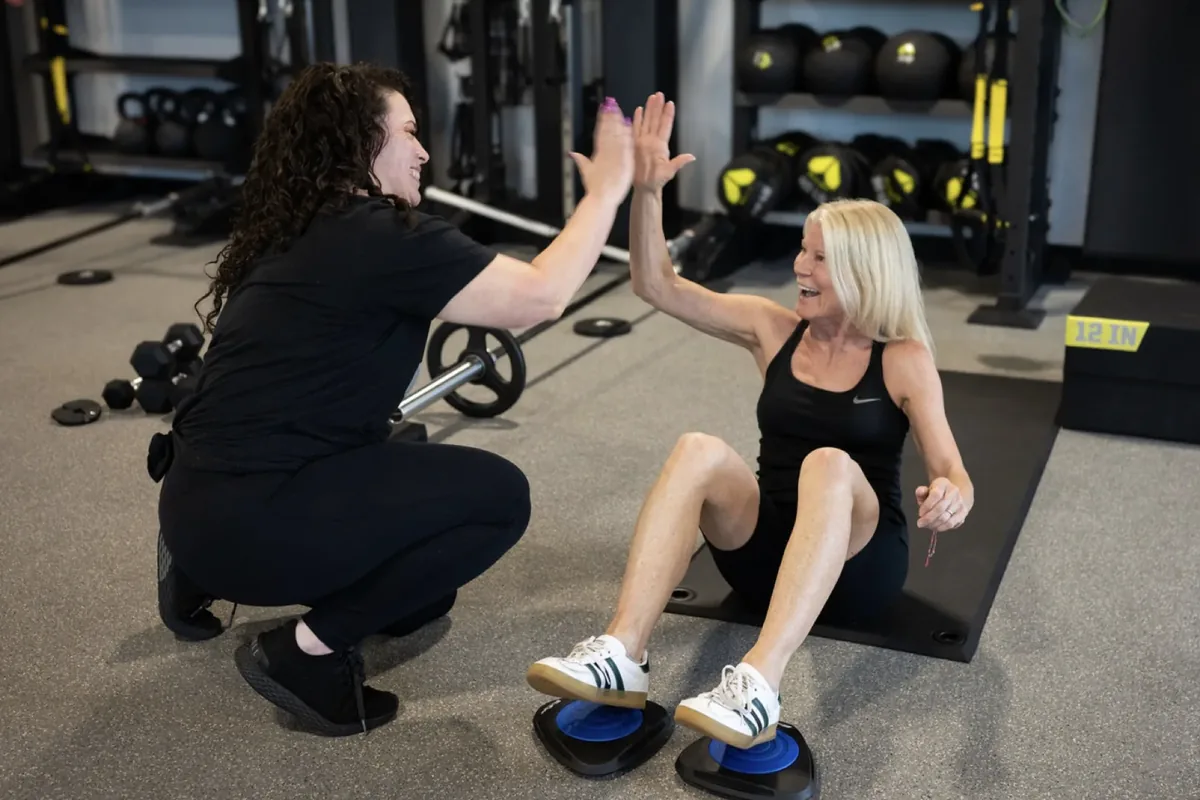
Why the best core exercises for adults over 60 are not crunches
Crunches train a small part of the job, in the one direction most people already do too much of.
Harvard Health puts it plainly in its guide to core exercises for older adults: sit-ups and crunches "are not as effective as we once believed," and they largely train the hip flexors rather than the deep trunk muscles.
The more useful model comes from spine researcher Stuart McGill, whose work on core training describes the core musculature as a system that stiffens the torso and prevents motion, transmitting power the hips generate. A strong core is not one that bends well. It holds position while something else moves.
That leaves three jobs to train, and all three show up before lunch.
| The job | What it resists | Everyday example | Exercises |
|---|---|---|---|
| Anti-extension | The low back arching overhead | Loading a top shelf | Dead bug, front plank |
| Anti-lateral flexion | Bending sideways under a one-sided load | Carrying one grocery bag | Side plank, carries |
| Anti-rotation | Twisting when force comes from one side | Catching a stumble | Pallof press, chop, bird dog |
None of those tasks involves lying on the floor and curling up. They involve staying stacked while the load moves around you, which is why core work belongs inside your strength training after 50.
What the research shows for adults over 60
Trunk training has been studied directly in this age group, and the findings are specific.
A systematic review in Sports Medicine found core strength training in older adults produced trunk strength gains of roughly 30% (effect size 0.99) and improvements of roughly 23% on balance and functional measures (effect size 0.88). Pilates-style programs produced smaller changes. The authors reported correlations between trunk strength and balance or function that were only small to medium.
A 9-week randomized trial in Gerontology shows what that looks like in practice. Among 32 participants, with the intervention group averaging 70.8 years old, trunk flexor strength rose 34%, extensors 21%, rotators 42%, and lateral flexors 48% to 53%. Functional reach improved 20%, with 92% compliance.
Both came from the same research group, so independent replication matters. A 2025 meta-analysis in Frontiers in Public Health pooled 11 studies covering 442 adults aged 60 to 85. Functional reach improved (standardized mean difference 0.82) and one-leg stance time increased by 3.19 seconds, with sessions of 45 minutes or longer outperforming shorter ones. One caveat: the Timed Up and Go effect started at SMD −0.81 and shrank to −0.16 after correction for publication bias, so reach and stance time are the steadier measures.
On falls, the careful version is this. Research links stronger trunk muscles and balance training with better balance and function, and large reviews of exercise programs show meaningfully fewer falls among older adults who train. The Cochrane review behind that second half pooled 108 randomized trials and 23,407 older adults living in the community and found exercise reduced the rate of falls by 23%. Those trials tested exercise broadly, with balance and functional training doing most of the work, so the figure belongs to exercise as a category, not to core training or any single routine. For context, the CDC reports that more than 1 in 4 adults aged 65 and older falls each year.
The reasonable expectation is what the trials measured: steadier stance, more reach without stepping, and a trunk that holds under a one-sided load.
The 8 best core exercises for adults over 60
Start at the version you can perform with clean form on every repetition, not the hardest one you can survive.
1. Dead bug
Why it works: It teaches the low back to hold still while the arms and legs move, the same demand as reaching overhead.
Form notes: Knees over hips, arms toward the ceiling. Press the low back gently toward the floor, ribs down. Lower one arm and the opposite leg while exhaling, stopping the moment the back lifts off.
Easier to harder: Heel taps with arms still, then opposite arm and leg with a bent knee, then the leg fully extended, then a light weight in each hand.
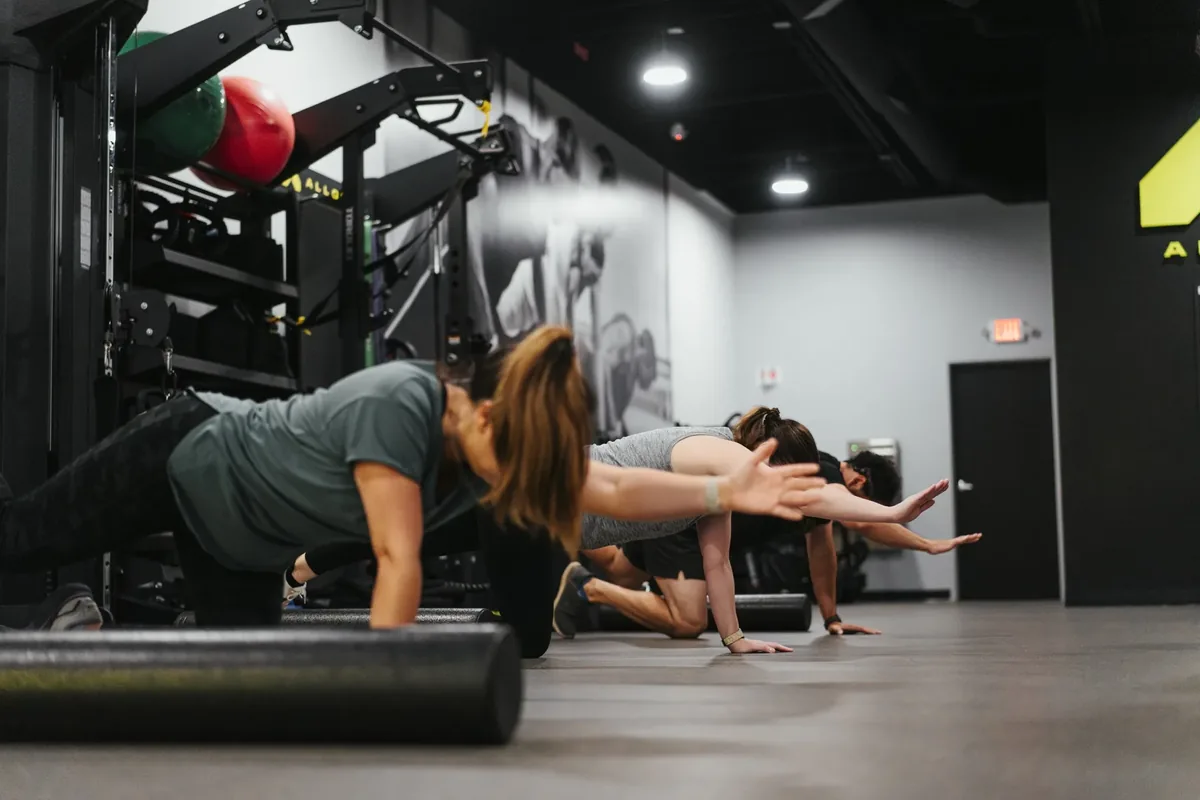
2. Bird dog
Why it works: It resists arching and twisting at once, from a position where spine load stays modest. A McGill staple.
Form notes: Hands under shoulders, knees under hips. Reach the opposite arm and leg out long rather than high, hips square, as if a glass of water on your low back should not spill. Pause 2 to 3 seconds.
Easier to harder: Arm only, then leg only, then both together, then slow the tempo and trace a small square with the extended hand.
3. Front plank
Why it works: It is the most direct anti-extension drill available, and the one most commonly ruined by holding it too long.
Form notes: Elbows under shoulders, a straight line from ear to hip to ankle, glutes on, ribs down, breathing throughout. Short repeats of 10 to 15 seconds beat one long shaky hold, because a sagging plank trains the position you are trying to avoid.
Easier to harder: Hands on a counter, then knees on the floor, then a full plank from the feet, then narrow the feet.
4. Side plank
Why it works: It trains the lateral trunk, including the quadratus lumborum, which McGill's carry research identified as generating frontal-plane torque to support the torso and pelvis. Same demand as carrying something one-handed.
Form notes: Elbow directly under the shoulder, hips stacked and lifted so the body forms one line, neck relaxed. Use the same short-hold rule as the front plank and match the time on each side.
Easier to harder: Forearm on a counter or wall, then knees bent on the floor, then a full side plank from the feet, then lift the top leg.
5. Farmer's carry
Why it works: It is the closest thing in a gym to carrying groceries in from the car. McGill's study of heavy carries described the stiffened torso as a source of strength during loaded walking, the trunk holding position while the hips and legs move.
Form notes: A weight in each hand, standing tall, shoulders level and down, ribs stacked over hips. Walk 20 to 40 feet at a normal pace and breathe. No leaning back, no shuffling.
Easier to harder: Lighter weights over a short distance, then heavier, then longer distances or a controlled turn at each end.
6. Suitcase carry
Why it works: Loading one side only forces the opposite side of the trunk to work to keep you upright. Uneven loads are what daily life actually hands you.
Form notes: One weight, one hand. Stand tall and refuse the lean toward the weight, keeping both shoulders at the same height. Walk, then switch sides and match the work.
Easier to harder: A short distance with a light weight, then heavier, then a 3 to 5 second pause mid-walk before continuing.
7. Pallof press
Why it works: It is the cleanest anti-rotation exercise there is. A band tries to twist you and you decline, with no impact and no floor work involved.
Form notes: Anchor a band at chest height and stand side-on with both hands at your sternum. Press straight out, hold 2 to 3 seconds, return under control. Hips and shoulders stay square, and keep breathing.
Easier to harder: Half-kneeling or closer to the anchor, then further away, then press and hold while taking two steps out and back.
8. Standing anti-rotation chop
Why it works: It pairs anti-rotation with standing balance, the combination national activity guidance asks older adults to train.
Form notes: Anchor a band low or high and move slowly along a diagonal. The arms travel, the hips stay square, the feet stay planted. Controlled beats heavy, because the balance demand is part of the point.
Easier to harder: A wide stance, then feet closer together, then a staggered stance.
How to put a core routine together
Two or three sessions a week is enough, and the work fits inside your strength days rather than replacing them.
The Physical Activity Guidelines for Americans recommend that adults 65 and older follow a multicomponent routine: balance work, aerobic activity, and muscle-strengthening activity, the last on at least 2 days a week. The exercises above cover strength and balance at once.
A workable structure is one anti-extension move, one anti-lateral-flexion move, and one anti-rotation move per session, two to three sets each, rotating which ones you use across the week. Keep holds short and repeat them rather than stretching one hold to failure. Sessions of 45 minutes or longer produced stronger results in the 2025 meta-analysis.
The most common mistake is chasing repetitions. Every exercise here is judged on position, not count. When the low back arches on a dead bug, the hips drop on a plank, or the shoulders tilt under a carry, the set is over. If floor positions are the sticking point, that is a range-of-motion question as much as a strength one, and the difference between mobility and flexibility is where the answer usually lives.
Why having a coach watch the position matters
Almost everything on this list is judged by something the person doing it cannot see: whether the hips stay square on a bird dog, whether the shoulders stay level under a suitcase carry, whether the low back has quietly left the floor during a dead bug.
Progressions are worth assigning rather than guessing, too, since the research above tested programs where difficulty moved as participants improved. Sessions in our studio run about 55 minutes and are capped at six members, with a coach leading start to finish and every exercise progressed or modified per person. Alloy Personal Training Billings has trained adults in their 40s through their 70s since 2022, and members do not simply join a gym, they join a coaching relationship. Here is how small group personal training works.
Frequently asked questions
Are crunches bad for adults over 60?
They are not automatically harmful, but they are a poor use of limited training time. Harvard Health notes that sit-ups and crunches largely train the hip flexors and are less effective than once believed. They also fail to rehearse what the trunk does all day: hold position while the arms and legs move.
How often should I train my core after 60?
Two to three sessions a week, folded into your strength training rather than treated separately. The Physical Activity Guidelines recommend muscle-strengthening activity on at least 2 days a week for adults 65 and older, along with balance and aerobic work. One exercise from each of the three categories covers the bases.
Can I do these core exercises seated?
Seated versions exist and are a legitimate place to start. Standing, loaded work is the better target, though, because national guidance asks older adults to include balance training and a chair removes that demand. Carries, Pallof presses and chops need no floor work at all, and both planks can be done with the forearms on a counter, lowering the incline over time. Getting up from the floor is itself a trainable skill that responds to the strength work in our guide to building muscle after 60.
Where to start in Billings
If you are not sure which version suits you, the fastest way to find out is to have someone assess how you move.
A Fitness Consultation at our South Shiloh studio includes a conversation about your goals, lifestyle and any physical considerations, an InBody body composition analysis, and a functional movement assessment. You leave with personalized recommendations and straightforward pricing at your consultation, no pressure and no games. Read what the Fitness Consultation covers, or go ahead and book your Fitness Consultation.
This article is general educational information, not medical advice. Talk with your doctor before starting a new exercise program.