
Choose a personal trainer in Billings by checking five things: an NCCA-accredited certification, a real assessment before your first workout, a written program that progresses, experience with people your age and your goals, and a format that fits your schedule and budget. Verify the certification yourself, then book a consultation.
The five-item checklist
- An NCCA-accredited certification. This is the floor, not the ceiling. It tells you someone independent tested the trainer's knowledge.
- A real assessment before any workout. A trainer who programs for you before measuring you is guessing.
- A written program that progresses. You should be able to see what you are doing this month and what changes next month.
- Experience with people your age and your goals. Coaching an adult back into lifting after a decade off is a different job than coaching a college athlete.
- A format that fits your schedule and your budget. The best program is the one you actually attend.
- NCCA accreditation is the minimum credential standard, and you can verify any trainer's certification free on the U.S. Registry of Exercise Professionals.
- A 2022 meta-analysis of 12 studies found supervision produced a moderate strength advantage (effect size 0.40) and a trivial body-composition difference.
- In a 2025 randomized trial, attendance was 88.2% with in-person supervision, 81.2% with an app, and 52.2% with a self-guided PDF.
- After 40, what matters most is assessment depth, joint history, pace of progression, and whether progress is tracked in numbers.
- Walk away from guaranteed transformations, one-size-fits-all workouts, and anyone who diagnoses an injury.
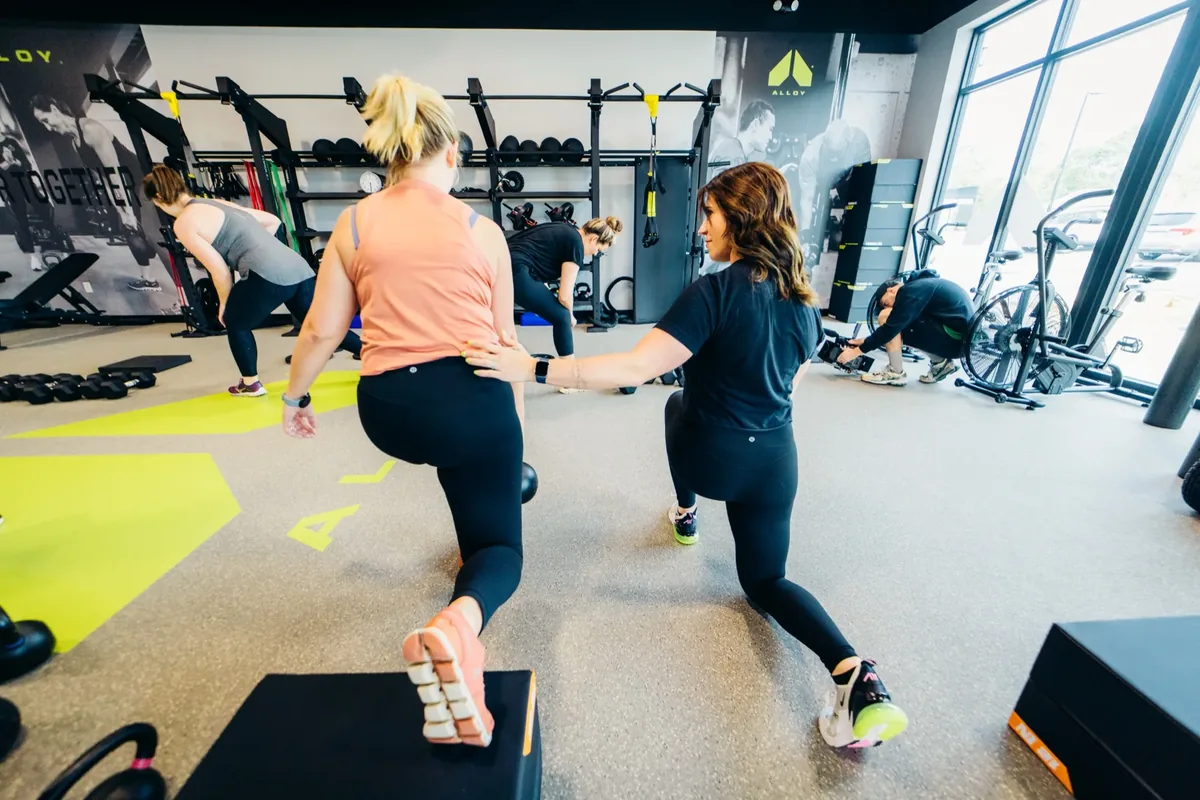
Start with the certification, and know what it actually tells you
The certification is a screening tool, not a ranking. It is usually the only standardized check anyone has applied before a trainer sits down to write you a program, which is why it belongs first on the list. The recognized floor is accreditation by the National Commission for Certifying Agencies (NCCA), an independent body that accredits the certification exam rather than the coursework sold alongside it.
You can verify this yourself in about a minute. The U.S. Registry of Exercise Professionals lists more than 130,000 active credentials and registers only certifications that are NCCA-accredited or compliant with ISO 17024, including ACE, ACSM, and NSCA. Searching a trainer's name is free.
Accredited certifications versus weekend certificates
The major certifications differ in emphasis more than in quality. Knowing the emphasis helps you predict how someone will coach you.
| Credential | What it emphasizes | Verification note |
|---|---|---|
| NASM-CPT | The OPT model, where assessment results drive the program design | NCCA-accredited |
| ACE-CPT | The IFT model plus behavior-change coaching | The ACE CPT exam is NCCA-accredited; ACE's separate non-proctored certificate is a different product |
| ACSM-CPT | A science-first approach with exercise-physiology roots | Registered on USREPS |
| NSCA CSCS | Athlete performance, with a degree requirement | Registered on USREPS |
Be aware that "certified" covers a wide range. Some specialty certificates are earned in a weekend with no proctored exam. They can be useful continuing education on top of a core credential, but they are not a substitute for one.
Why coaching is worth paying for, according to the research
The measurable benefit of supervision shows up in strength and adherence, not in the mirror. A 2022 meta-analysis in the International Journal of Strength and Conditioning pooled 12 studies covering 301 supervised and 276 unsupervised trainees and found that supervision produced a moderate advantage in strength (effect size 0.40, 95% CI 0.06 to 0.74) and a smaller advantage in overall performance and function (0.28). The body-composition difference was trivial at 0.07.
That is a useful thing to know before you hire anyone. You are buying skill instruction, load management, and the fact that you show up.
Showing up is where the gap gets wide. In a 2025 randomized controlled trial published in the Journal of Strength and Conditioning Research, 79 trained adults were assigned to 10 weeks of in-person supervised training, app-guided training, or a self-guided PDF program. Attendance was 88.2%, 81.2%, and 52.2% respectively, and the supervised group added more to their squat one-rep max (26.6 kg versus roughly 19 kg in the other two groups). An earlier eight-week trial in the Journal of Sports Sciences gave 36 trained adults identical programs and varied only supervision; the supervised group gained more muscle thickness and squat strength and adhered better.
None of that guarantees a result for any individual. It does explain what a good trainer is actually selling.
What changes when you are choosing a trainer after 40
The criteria shift from intensity to precision. Two research syntheses, which overlap somewhat in the trials they include, point the same direction. A 2017 review in Sports Medicine covering 11 studies in adults 65 and older found supervised training outperformed unsupervised on strength and power (SMD 0.51) and balance (SMD 0.53), and its authors suggested supervising roughly two of every three weekly sessions.
A 2024 Sports Medicine review of 30 randomized trials in 2,830 adults aged 60 and over found supervised training edged out home-based training for knee-extension strength, gait speed, timed-up-and-go, and lean mass. Worth noting: attendance in that review was comparable between settings in recent trials, about 81% in both, so the adherence argument rests on the trials above rather than on this one.
Practically, a trainer who is good with adults over 50 will ask about surgeries, joint history, and what hurts before handing you a barbell. They will test a movement before loading it, add weight in small steps, and write the numbers down. They will also know the line: a coach can modify around a cranky knee and refer you out, but never diagnose it.
Guidelines give you a target to hold them to. The current Physical Activity Guidelines for Americans call for 150 to 300 minutes of moderate aerobic activity per week plus muscle-strengthening work for all major muscle groups on two or more days, with balance and multicomponent training added for adults 65 and older, and advise starting low and going slow. Adults with chronic conditions should talk with a health-care provider about what fits. If you want more depth on programming in this age range, we covered it in strength training over 50 in Billings.
What a real assessment and program look like
A first session should leave you with information, not soreness. The pattern to look for is a conversation about your goals, schedule, and physical history, followed by objective measurements and a movement assessment, followed by a plan you can read. A trainer who opens with a maximal workout is demonstrating effort, not competence, and the demonstration comes out of your recovery budget.
The written plan matters as much as the assessment. Ask to see how progression is decided: what gets heavier, when, and based on what. Then ask what gets remeasured and how often. If nothing is tracked, nobody can tell whether the program worked or whether you simply got used to it. Our walkthrough of what happens at a fitness consultation shows the sequence in practice.
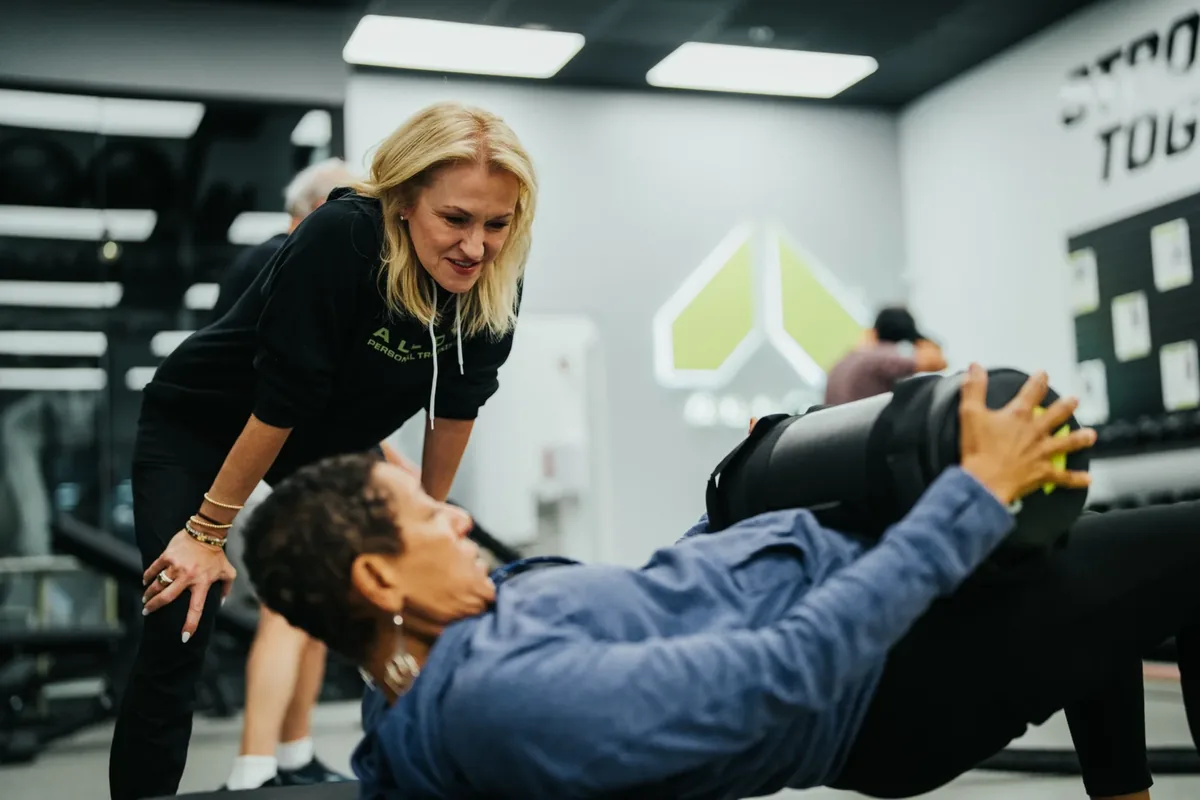
One-on-one, small group, or an app
Pick the format that keeps a qualified coach in the room at a price you can sustain. That is the practical reading of the evidence, because the trials above compared supervised with unsupervised training, not one group size against another. What moved the numbers was a coach watching and a program built for the individual.
That framing makes small group training worth a look. It keeps live coaching and individualized programming while spreading the cost of the coach's hour across several people, which usually lands well below one-on-one per session. App-based training sat in the middle for adherence in the 2025 trial, and fully self-guided training is where attendance fell apart. For how the money side compares across formats in this market, see our breakdown of personal trainer cost in Billings.
Group size is the variable to ask about. A class of 25 with an instructor at the front is a different product from a coached session of six, even though both get called "group training." Alloy Personal Training Billings caps small group personal training sessions at six members, with every exercise progressed or modified for the person doing it.
Red flags worth walking away from
Any one of these is a reason to keep looking.
- No assessment. A program written before anyone looked at you is a template with your name on it.
- The same workout for everyone in the room. Individualization is the entire premise of personal training.
- "No pain, no gain." Soreness is not a measure of programming quality, and pain is information.
- Guaranteed transformations. Nobody can promise a specific outcome on a specific date. Marketing that does is telling you what it values.
- A long contract before you have trained once. A consultation and a clear look at the program should come first.
- Supplement sales built into the coaching. Commission and coaching advice are a poor mix.
- Diagnosing your injury. A trainer who names your condition is doing a job they are not licensed to do.
10 questions to ask at your first consultation
Write these down and bring them. A good trainer will not mind, and how someone handles the list tells you most of what you need to know.
- Which certification do you hold, and can I verify it on USREPS?
- How much of your current roster is over 40, and what are they working on?
- What exactly happens in the assessment, and what do you measure?
- How is my program written, and how do you decide when something gets heavier?
- What numbers do you retest, and how often?
- How many people are in a session, and what is the coach-to-member ratio?
- How does scheduling work, and what is your cancellation policy?
- Can I try a session or see the program before committing?
- If my knee is cranky one week, what do you do about it?
- What does the first month look like, and who is your ideal client?
Question nine is the quiet one. The answer you want involves modifying the session and, if it persists, referring you to a professional who diagnoses for a living.
Finding a personal trainer in Billings
Start with format, then verify credentials, then talk to a human. Directories such as Fyt, Thumbtack, and Yelp will list dozens of trainers in Billings, Montana in a few clicks, but a listing is a paid or crowdsourced placement, not a vetting. Use them to build a short list, then run each name through USREPS and the ten questions above.
The local options sort into a few formats. Big-box gyms sell training as an add-on to a membership, usually one-on-one at a per-session rate. The YMCA and community facilities offer training alongside broad programming. Dedicated studios tend to run smaller rooms and one coaching model. None is automatically the right answer; they solve different problems, and we compared the tradeoffs in our guide to choosing a gym in Billings.
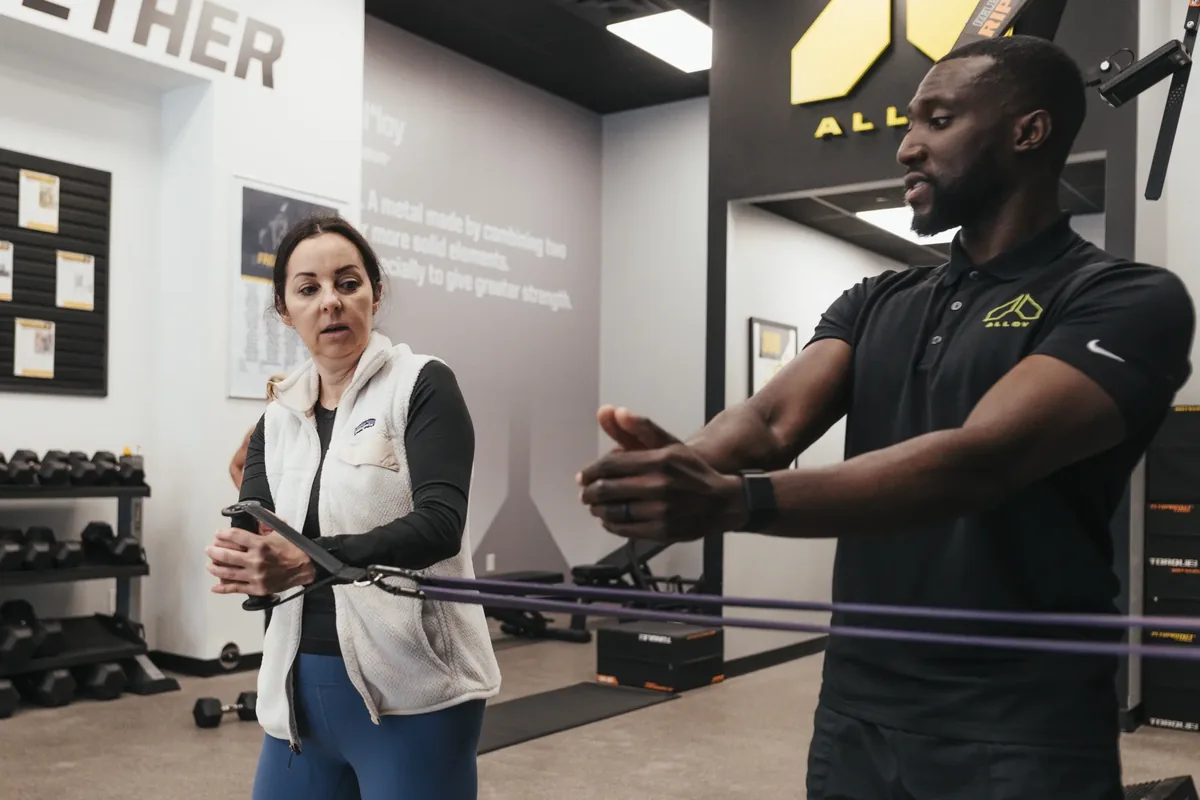
Book a Fitness Consultation
If you want to put the checklist to work, book a Fitness Consultation with our coaches. It starts with a conversation about your goals, your schedule, and any physical considerations, then includes an InBody body composition analysis and a functional movement assessment, and ends with recommendations built around what we found. You get straightforward pricing at your consultation, with no pressure and no games. Bring the ten questions.
Book Your Fitness Consultation
Frequently asked questions
How do I verify a personal trainer's certification?
Ask which certification they hold, then search the free U.S. Registry of Exercise Professionals, which registers only NCCA-accredited or ISO 17024-compliant credentials. A trainer who will not name their credential has answered the question.
What is the difference between NASM, ACE, ACSM, and NSCA?
Mostly emphasis. NASM's OPT model builds the program from assessment results. ACE's IFT model pairs programming with behavior-change coaching. ACSM comes from an exercise-physiology and science-first tradition. NSCA's CSCS is the athlete-performance credential and carries a degree requirement. All four are registered on USREPS, so choose on coaching style and experience rather than on the acronym.
Is small group training as effective as one-on-one?
The research does not answer that head to head. What the trials compared was supervised training against unsupervised training, and the supervised groups came out ahead on strength and adherence. So the question to ask is whether the group keeps what drove those results: a qualified coach watching your sets, and a program written for you rather than for the room.
This article is general information for educational purposes, not medical advice. Talk with your doctor before starting a new exercise program.
How often should I train with a trainer?
The Physical Activity Guidelines call for muscle-strengthening work covering all major muscle groups on at least two days a week, alongside 150 to 300 minutes of moderate aerobic activity. For adults 65 and older, the 2017 Sports Medicine review suggested supervising about two of every three weekly sessions, which is a reasonable starting frame for deciding how much coaching to buy.